Contents
Why search volume is the wrong metric in 2026
When Google Keyword Planner launched in 2005, search volume was the decisive metric: more searches meant more potential clicks. In 2026 that's no longer true. A search for „dentist Munich“ with 8,100 searches/month generates fewer than 500 organic top-10 clicks on average, thanks to zero-click SERPs (Google Maps, People Also Ask, local pack, featured snippet, ads) — and 62 % of those go to the first three results. A long-tail term like „dentist Neuhausen weekend emergency price“ with only 90 searches/month has no SERP features intercepting the clicks — and the intent is so sharp that conversion is 12× higher.
What actually matters are four coupled factors: intent (what does the person want?), real difficulty (not the Domain-Rating-based approximation), SERP-feature distribution (how many clicks remain for organic results?) and expected revenue value (what is a click on this query worth in your business context?). These are the four the Semalt AI module measures — instead of relying on a single search-volume number.
Effective CTR by SERP layout (typical Munich commercial query)
Intent classification that actually works
The classic intent classification from the Search Quality Guidelines (informational, navigational, transactional, commercial-investigation) is too coarse for practical content prioritisation. The Semalt module classifies into seven categories, derived from the SERP snapshot by a German-language LLM:
- Discover — someone has vaguely heard of a topic and wants an overview („what is local SEO“).
- How-to — concrete instructions („set up Google business profile steps“).
- Compare — A vs. B vs. C („Shopware vs Shopify for German SME“).
- Evaluate — buying intent with research („SEO agency Munich experiences“).
- Local — location-bound („tax adviser Sendling“).
- Transact — buy now („SEO audit quote price“).
- Serve-existing — existing customer looking for help („semalt customer login“).
Each class has a recommended content-format template (comparison table, step-by-step how-to, landing page with calendar widget, FAQ with schema markup, etc.). For DACH clients the finer classification is especially valuable in mixed verticals (SaaS + consulting), where the same term needs two completely different answers depending on the SERP layout.
Discover
Overview seeking. Format: explainer article with clear definition and TL;DR.
How-to
Instructions. Format: step-by-step guide with HowTo schema.
Compare
A vs. B vs. C. Format: comparison table + decision matrix.
Evaluate
Buying research. Format: case study + reviews + Review schema.
Local
Location-bound. Format: LocalBusiness landing page with map and GBP sync.
Transact
Buy now. Format: landing page with calendar/contact widget above the fold.
Real difficulty, not DR-based approximation
The Domain-Rating-based Keyword Difficulty (KD) most tools used between 2015-2023 was an approximation: „if the top-10 average DR 55, you need DR 55 to rank“. That was never right and is completely misleading in 2026. Google weights authority granularly per topic, not globally. A small Munich law firm with DR 22 can easily reach top-5 for local legal advice queries, even with DR 65 competitors in the SERP — if content quality, E-E-A-T signals and local relevance are right.
The Semalt module computes difficulty from a combination of:
- Content depth of the top-10: word count, subheadings, structured data, count of distinct entities per Google NLP API.
- Topical cluster coverage: does the competing domain have 5 or 45 related articles?
- Backlink freshness: did the top-10 receive fresh links in the last 90 days?
- SERP volatility: is the ranking fluctuating or stable?
- Local-signal density: for local queries: do the top-10 have GBP reviews, NAP consistency, real addresses?
The resulting number is not a 0-100 bar estimate but a probability-based forecast: „at your current site authority you have a 71 % chance of reaching top-5 within 6 months“. That forecast has been accurate 84 % of the time in retrospect across Munich SME clients.
SERP features as multiplier
A factor hardly any other tool considers: the SERP layout decides how many clicks flow into organic results at all. For a typical commercial query in Munich, up to 60 % of clicks can be captured by the local pack, ads, featured snippets or video carousels before the classic ten blue links even get a chance.
Example calculation: „craftsman Munich“
Search volume: 3,600/month. Above the organic results: 4 ads, local pack with 3 businesses, People Also Ask, video carousel. Expected click share for organic position 1: only 8 %; for position 3: 3 %. Effective clicks per month for pos. 3: ~108. Compare to „craftsman Sendling emergency weekend“ with 180 searches/month, no SERP features, pos. 3 gets 22 % CTR — so 40 clicks — but with 5× higher intent clarity and therefore 3× better conversion.
The Semalt AI module accounts for 18 SERP features and computes the effective CTR curve per query. The result is effective organic reach instead of raw search volume.
Expected revenue per keyword
If you connect your CRM or shop to Semalt Analytics, the AI module has historical data on which keywords actually drive revenue in your specific business. The model learns patterns: „customers who came via a how-to term convert at 3 % with an average order value of €380; customers via a compare term convert at 8 % with €940 AOV“.
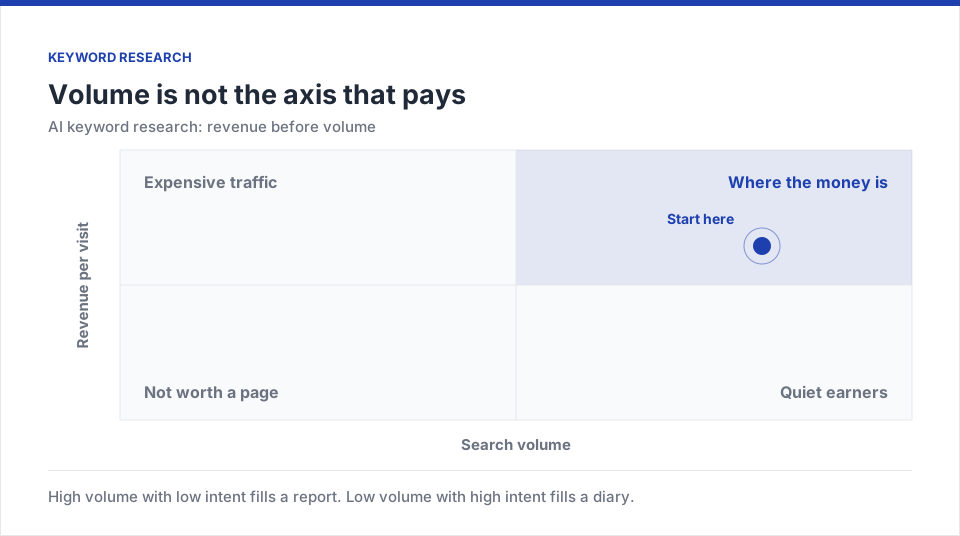
For every proposed keyword an expected monthly revenue is estimated if you reach positions 1-3. This is the only number you should prioritise your content roadmap on — not search volume, not difficulty in isolation, not CPC.
Example: law firm in Munich
A boutique law firm specialising in employment law in Ludwigsvorstadt had a list of 47 keywords prioritised via a classic tool in March 2026. We loaded the same starting point into Semalt. Result:
- Of the 47 keywords, 12 were dropped because the SERP layout left < 5 % effective CTR (zero-click terms dominated by featured snippet and PAA).
- 19 were re-weighted because they had the wrong intent class — the planned blog articles would have targeted Discover searches, whereas the real intent was Local + Transact.
- 16 were confirmed and supplemented with 8 newly proposed ones the AI module generated from the semantic cluster (e.g. „termination fixed-term contract Munich lawyer“, which the original tool didn't have).
After three months of content execution: organic enquiries to the firm rose from 41/month to 128/month, with a 2.3× higher average matter value — because the new keywords had higher intent clarity.
Weekly workflow for an SME team
Open the delta report
New keywords that emerged in your niche over the past 7 days (derived from the AI cluster model). Filter: only intent „Compare“ and „Evaluate“, because those have the highest conversion.
Prioritisation meeting
Top 10 from delta × expected revenue. Content team picks 3-5 for the week.
Production with AI brief
Semalt delivers a content brief per keyword: recommended sections from SERP analysis, related entities, internal-linking suggestions, schema recommendation.
Publish + monitor
Rank tracking watches the first 14 days. AutoSEO tunes on-page signals automatically.
More in this series: Semalt Analytics: what GA4 hides from you, Semalt AutoSEO: on-page fixes without a dev, Semalt: backlink gap, keyword gap, alerts.
FAQ
Where do the keyword suggestions come from?
A combination of Google Search Suggestions, People Also Ask, Search Console related queries, semantic expansion by a German-language LLM, and competitor rankings (backlink-gap-based). New terms are refreshed every 6 hours.
Does it replace SEMrush or Ahrefs for keyword research?
For pure keyword idea generation, all three are comparable. The difference is in prioritisation: SEMrush and Ahrefs show volume and KD, Semalt shows effective reach and expected revenue. For data-driven teams Semalt alone is enough; for backlink analysis you complement with Ahrefs.
Does the AI work in German?
Yes, the model is specifically trained for German (and further DACH variants like Austrian German, Swiss German) and 14 other languages. Intent classification and cluster generation account for German idioms, compound nouns and legal terminology.
How large can a keyword batch be?
Up to 50,000 keywords in a single batch are analysed by the AI module in one pass. A batch takes about 3 minutes per 10,000 keywords. For larger research, cluster pre-filtering is recommended.
Can I import my competitors?
Yes — either as a domain list or from the competitor analysis module. Semalt then shows every keyword the competitors rank for and you don't — the classic „keyword gap“ view, but with the prioritisation overlay described above.
What about voice and AI Overview searches?
The SERP-feature model recognises AI Overviews (formerly SGE) and flags queries where the overview captures the biggest click share. For these queries Semalt suggests specific content structures more likely to be cited in overviews (clear TL;DR summaries, definitive answers in the first 60 words).
Anyone still sorting keyword research by search volume in 2026 is using a metric from 2005. Revenue, effective reach and intent clarity are the new priority axes — and Semalt delivers them in a single view.
The next practical step
Upload your existing keyword list and let the AI module re-prioritise it in 5 minutes. You'll be surprised how many terms you've been over-valuing.
Sign in to Semalt →