Contents
Who is actually your competitor?
The most common misconception among Munich SME marketing teams: the SEO competitor is not the classical business rival. A dentist in Sendling competes in the SERP with portals like jameda.de, doctolib.de or sanego.de — not with the practice on the next street. An SEO agency in Munich competes with t3n.de, seokratie.de and impulsq.de — not with the rival agency in Schwabing.
The Semalt module identifies your real SEO competitors automatically by finding the domains that appear in the top-20 for the most of your target keywords. That list is often surprising — and practical to work with. Only once you know your actual competitors does everything else in this guide start to work.
Auto-discovery
Finds the domains that appear in the top-20 for most of your target keywords — often surprisingly different from your offline rivals.
Backlink intersection
URLs linking to N of N competitors but not to you — the shortest path to new authority.
Delta alerts
Slack / Teams / email push when competitors publish new content or update pricing.
Content diff
6-hour interval detects text changes > 15 % delta — you see when an important landing page is rewritten.
Backlink gap: the fastest content gold vein
A backlink gap is a URL on the web that links to several of your competitors but not to you. If the same trade journal, the same industry directory or the same blog mentions two or three of your competitors and not you, the probability is high that you can earn a link there with comparable effort.
Classic backlink tools show lists of backlinks. Semalt shows the intersection — the URLs that link to N out of N competitors. For one Munich trade contractor client we found:
- 34 industry directories listing 4 out of 4 competitors but not our client. Cost per listing: €0. Time-to-link: 6 days.
- 12 local blogs (Isarblog, Münchner Stadtplan, Sendling-Blog) mentioning 3 out of 4 competitors in listicles. Time-to-link: 3 weeks with a well-written case-study pitch.
- 5 guest-article opportunities on chamber-of-crafts portals. Time-to-link: 6-10 weeks because of editorial cycles.
Within 4 months the client's backlink count was on par with the competitors — and traffic share in the local pack rose from 8 % to 21 %. That's the fastest way to close a gap without spending years building up content authority.
Keyword gap with intent filter
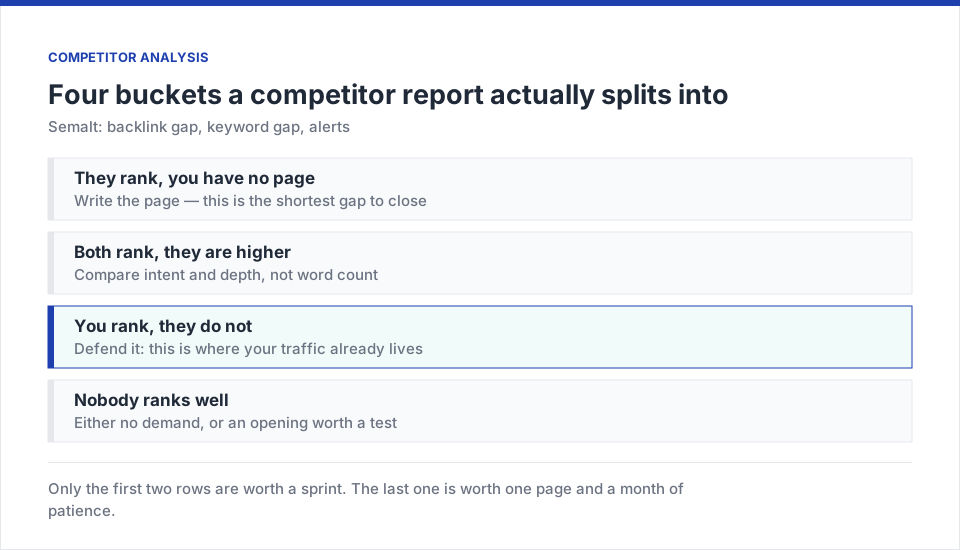
The keyword gap shows which search terms your competitors rank for in the top-10 and you don't. On a typical Munich agency website Semalt finds between 800 and 4,000 such terms. That's too many to work through sensibly — and most tools offer barely any filters to narrow the list.
Semalt combines the keyword gap with the filters from the AI research module: you can filter by intent (only „Compare“ and „Evaluate“), by expected revenue (only terms that could generate at least €500 monthly pipeline), or by SERP-feature distribution (only terms where > 30 % effective CTR flows into organic results).
Real case: tax adviser in Maxvorstadt
Raw keyword gap: 2,340 terms 3 competitors ranked for and our client didn't. After filter (intent = Evaluate + Transact, expected monthly revenue > €800, effective CTR > 25 %): 47 terms. Of those, 22 became content briefs in Q1 2026. After 90 days: 14 in the top-10, 3 in the top-3, 7 new mandates directly attributable.
Change monitor: SERP, content and prices
The most valuable part of competitor analysis isn't the current state but the movement. When a competitor publishes new content tomorrow, changes their price list, or loses an important backlink — those are signals you should react to fast.
The Semalt change monitor watches four dimensions per defined competitor domain:
- SERP movements: for every shared keyword, daily monitoring of who gains or loses positions.
- New content publications: RSS, sitemap delta and 6-hour HTML crawls detect new blog articles or landing pages.
- Content updates: for existing URLs, text changes are detected (diff > 15 % delta). Especially interesting when a competitor changes their price list or updates a case study.
- Backlink delta: new or lost backlinks per domain, with origin page and anchor text.
All signals can be configured as daily summaries or real-time alerts via Slack, Microsoft Teams or email. For DACH customers the content-update alert is particularly valuable, because German B2B content cycles are slower — when a competitor rewrites an important article, they're the first to benefit unless you react within a few weeks.
Why „no trace“ matters
An often overlooked aspect of competitor analysis: many tools leave digital fingerprints on the target servers. When you crawl a competitor's site with Screaming Frog, the server admin sees the user-agent, your IP range and the access frequency. With Ahrefs-based tools the user-agent is well known and actively blocked (or redirected to fake preview content to poison competitor research) by some law-firm and rival sites.
The Semalt crawler uses a rotating pool of residential IPs in Germany, Austria and Switzerland, respects robots.txt and rate limits, and only identifies as „SemaltBot“ if the target site explicitly allows it. For most clients this means: the competitor doesn't notice they're being observed.
Not grey-hat, professional diligence
This is not web-scraping abuse. Semalt strictly follows TDDDG, GDPR and technical standards, respects robots.txt, and honours HTTP 429/503 signals. The anonymity serves the legitimate purpose that the competition can't sabotage the analysis with targeted misinformation.
Example: real estate agent in Bogenhausen
An established real estate agent in Bogenhausen wanted to expand their digital market share in the local segment in 2026. We set up Semalt with 4 competitors: 2 boutique Munich agents and 2 large portals (immoscout24.de, immowelt.de).
- Week 1: backlink-gap report identifies 89 links that 3 of 4 competitors have and our client doesn't. Priority by local relevance: 34 Munich blogs / portals / local newspapers.
- Week 2-6: outreach campaign with a purpose-built „Bogenhausen residential market analysis Q2 2026“ as content piece. 22 backlinks won, 6 with DR > 40.
- Week 5: change monitor reports one of the competitors published a blog post „Munich real-estate 2026 forecast“. Within 8 days we ship a longer, chart-widget-equipped competing article.
- Month 4: our client ranks for 148 local terms in the top-10 (previously 63), contact-form enquiries +71 %, verified new mandates +9 (mid-five-figure combined commission value).
The ROI of the competitor analysis alone — without the other Semalt modules — was 12× the annual licence cost within 3 months. It's where we start with almost every client.
Classic backlink tools
Show lists. You have to filter manually what several competitors share. With 4 competitors of 5,000 backlinks each: 20,000 rows, humanly infeasible.
Semalt backlink gap
Shows the intersection directly: which domains link to 3+ of your competitors and not to you. Usually 40-100 high-quality targets — workable in a sprint week.
More in this series: Semalt Analytics: what GA4 hides from you, Semalt AutoSEO: on-page fixes without a dev, AI keyword research: revenue before volume.
FAQ
How many competitors can I monitor at once?
Up to 15 on the standard tier, up to 50 on the enterprise tier. Ranking and backlink delta analysis scales linearly — 15 competitors doesn't feel noticeably slower than 3.
How fresh is the backlink data?
Semalt combines its own crawls (every 6 hours for prioritised domains) with partner data from majestic.com and its own CommonCrawl cooperation. Median time to detect new backlinks: < 48 hours.
What if a competitor has Cloudflare bot management enabled?
Applies to ~7 % of DACH sites. Semalt then falls back to publicly available data (Google Cache, Wayback Machine, public sitemaps) and marks data quality as „restricted“. In practice this is enough for 90 % of analytical questions.
Is it legally sound?
Yes. The crawler respects robots.txt (including new ai-robots.txt proposals), TCP rate limits and HTTP response codes. Analysing publicly available content signals is explicitly permitted under German law (§ 44b UrhG) and the EU DSM Directive as text and data mining.
How often does the change monitor update?
SERP positions: daily. Backlinks: every 6 hours for active domains, every 24 hours for less-frequent ones. Content diffs: 6-hour interval. Alerts can be pushed in near real time for critical competitors.
Can I forward alerts to an external system?
Yes. Slack and Teams webhooks natively, generic HTTP webhooks for Zapier, n8n, Make or your own systems. A REST API exists for deeper integrations.
Competitor analysis is the fastest lever in SEO because you don't have to be creative — you use the work competitors have already done as a map. Semalt makes that map visible in real time, without anyone noticing.
The next practical step
Add 3 of your competitors and run the backlink-gap module. In 15 minutes you'll have the list of links you're missing right now.
Sign in to Semalt →